The Toll Booth on the AI Highway 🚦
It's no secret that Arm Holdings (NASDAQ: ARM) is a critical piece of the artificial intelligence puzzle. But how often do investors actually think of Arm as a top-shelf AI play? It's easy to overlook this compounder amid the glitzy hypergrowth of Nvidia's and AMD's expensive AI accelerators.
Arm doesn't build the chips that train large language models. In fact, the company doesn't build chips at all. Instead, Arm designs fundamental instruction sets and CPU cores, licenses those designs to anyone with a fab contract and ambition, and collects a royalty on every unit shipped. It's essentially a toll booth on a road that keeps getting wider. 📌
Key Data Points
| Metric | Value |
|---|---|
| Market Cap | ~$294B |
| Current Price | ~$275 |
| Day's Range | $261.65 – $275.78 |
| 52-Week Range | $100.02 – $452.70 |
| Gross Margin | 93.88% |
| Volume | 7M (Avg 5.4M) |
The gross margin tells the whole story here — 93.88% is software-like economics dressed up as a semiconductor business.

The Toll Road Now Runs Through the Data Center 🏗️
Arm's toll road used to run almost entirely through smartphones. Now it runs through the data center too. Nvidia's Vera CPU pairs Arm cores with its accelerators. Amazon's Graviton, Microsoft's Cobalt, and Alphabet's Google Axion are all Arm-based, built in-house by companies that spend like nation-states on server capacity.
Every AI cluster on the planet needs general-purpose compute to feed the high-speed AI accelerators, handle networking, and run the orchestration layer. A growing share of that work sits on Arm designs.
Climbing the Value Chain
The newer wrinkle is that Arm keeps climbing the value chain:
- Armv9 architecture commands higher royalty rates than the model it replaced
- Compute subsystems — pre-validated bundles of cores and interconnect — let customers skip years of design work while paying Arm considerably more per chip
- Royalties per chip are getting richer while unit volumes accelerate
This is a rare combination: rising ASP (average selling price) and rising volume. Most semiconductor companies get one or the other — Arm is getting both.
The market is deeply divided on whether Arm's valuation is justified. Here's how the bull and bear cases stack up:

Better Growth Than the Smartphone Era 📈
The AI boom isn't Arm's first rodeo. Pretty much every smartphone ever built was based on an Arm-based CPU. But the peak growth years of the early smartphone era can't compare to recent financials.
Growth Comparison
| Period | Revenue Growth |
|---|---|
| FY2011 | 21% YoY |
| FY2012 | 17% YoY |
| FY2024 | 23% YoY |
| FY2025 | 24% YoY |
And that's from a much larger revenue base in each calculation. Compounding at 23-24% on top of a business generating billions in revenue is a different beast entirely from the early smartphone ramp.
Valuation Reality Check
To be fair, Wall Street is starting to pay attention. The stock has outperformed Nvidia over the last month, year, and three years as of mid-September. It's also richly valued at 55x trailing sales and 188x free cash flow.
For context, that's the kind of multiple typically reserved for hypergrowth SaaS companies, not semiconductor IP licensors.
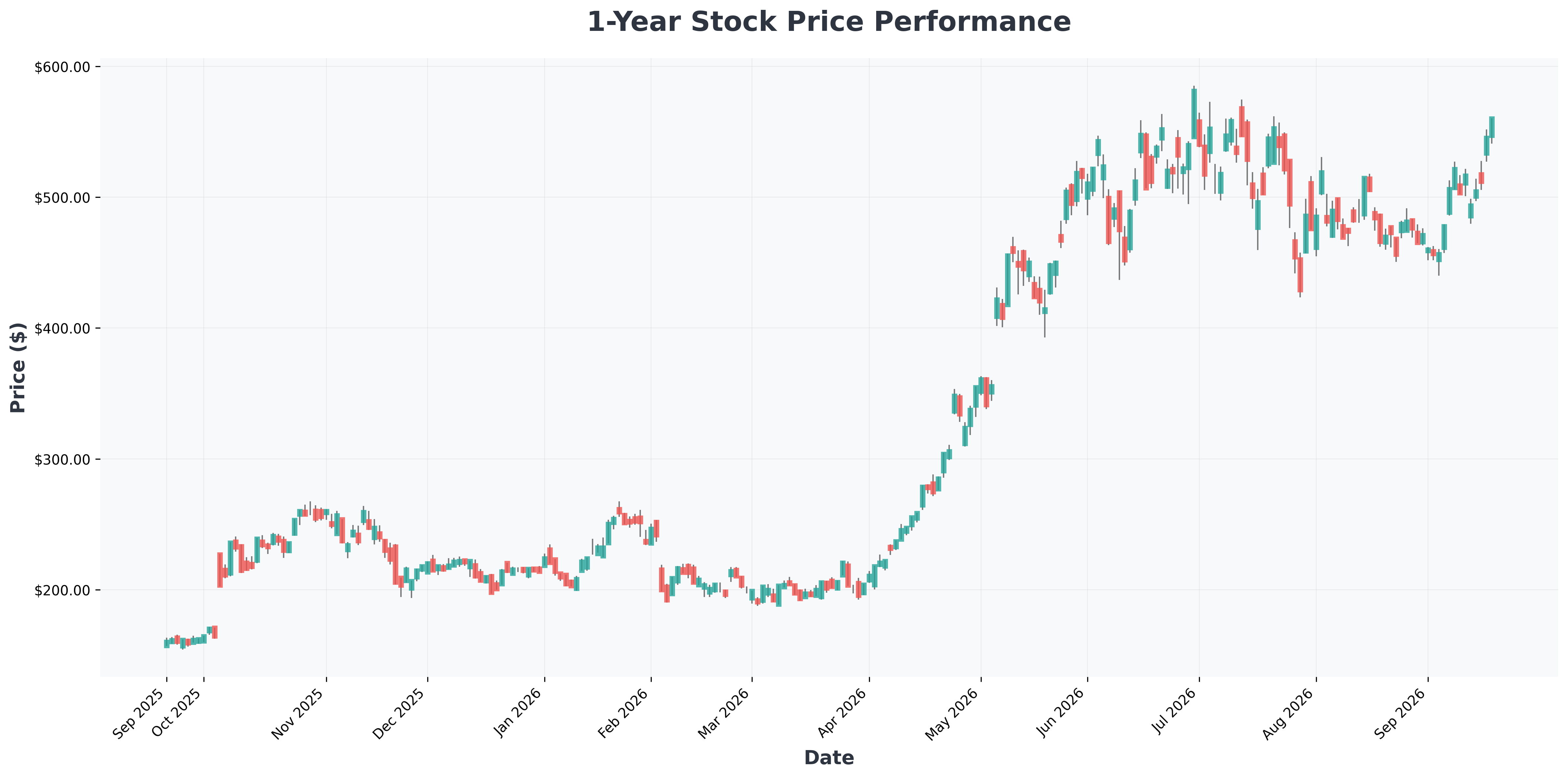
💡 Technical Note: Looking at the chart, ARM has been consolidating after its 52-week high of $452.70. The $260-$275 zone appears to be a near-term support area, with the broader $100 low from earlier in the year representing the deep-value floor. A break above $300 with volume could signal renewed momentum, while a loss of $260 would open the door for a retest of lower levels.
📊 In-Depth Fundamental Analysis
| Company | Share Price | P/E Ratio | P/B Ratio | ROE | Operating Margin (OPM) | Revenue Growth |
|---|---|---|---|---|---|---|
| AMD (Advanced) | $560 | 142.81 | 13.59 | 10.20% | 17.25% | 50.10% |
| AMZN (Amazon.com,) | $254 | 20.41 | 4.96 | 30.56% | 13.69% | 19.60% |
| ARM (Arm) | $276 | 278.39 | 34.11 | 13.35% | 7.60% | 22.40% |
| GOOG (Alphabet) | $344 | 17.27 | 6.77 | 48.68% | 34.03% | 24.20% |
| GOOGL (Alphabet) | $350 | 17.55 | 6.87 | 48.68% | 34.03% | 24.20% |
| NVDA (NVIDIA) | $222 | 28.10 | 23.44 | 117.21% | 66.24% | 105.90% |
| MSFT (Microsoft) | $494 | 27.48 | 8.29 | 34.04% | 45.11% | 17.70% |

The Bottom Line: Still a Hidden Winner? 🎯
Bull Case (Best Scenario):
- Armv9 and compute subsystems drive royalty rates higher across the entire industry
- Data center share continues to expand as hyperscalers design more Arm-based silicon
- AI inference (not just training) becomes the dominant workload, where Arm's efficiency advantage matters most
- Multiple compression happens gradually through earnings growth rather than price decline
Bear Case (Worst Scenario):
- RISC-V open-source architecture gains meaningful traction and erodes Arm's licensing moat
- Hyperscalers accelerate in-house designs and reduce dependence on Arm's roadmap
- Valuation at 55x sales leaves no room for execution errors
- A broader AI capex slowdown hits royalty volumes across the board
The Final Word
So Arm is less of a secret every day, as shown in the price chart. You're still likely to raise eyebrows if you drop this name around the next AI-stock watercooler chat. And then you can discuss whether the stock is worth 55 times sales. Careful — it's a short lunch break. ☕
Investors should be aware that semiconductor IP licensing carries concentration risk, and any investment in ARM should be sized appropriately within a diversified portfolio.
함께 보면 좋은 글
- Oil & Gas Production Software Market to Hit $4.22B by 2031 Driven by Digitalization & Stricter Regulations
- Oil Prices Are Climbing: 3 Energy Stocks Still Yielding Over 3%