Nvidia (NVDA) has lost its crown as the world's most valuable company to Apple, which has surged 27% over the past three months while NVDA slid 8%. 📊 This shift has investors questioning whether the AI trade is losing momentum. However, a closer look at the underlying fundamentals reveals a more nuanced picture.
The market's concern isn't about Nvidia's current performance but its future growth sustainability. With a price-to-sales ratio of 19x trailing revenue, the stock is priced for perfection. Any hint of deceleration in AI spending could trigger a significant de-rating.
The Hyperscaler Capex Boom: A Double-Edged Sword 🗡️
While the market worries about an AI bubble, the world's largest tech companies are doubling down. Alphabet and Amazon are each planning to spend around $200 billion in 2026 alone on AI infrastructure. This is unequivocally positive for Nvidia, as a significant portion of this capital expenditure flows directly to its data center GPUs.
Nvidia's CEO Jensen Huang projects total AI spending to reach $1 trillion next year and up to $4 trillion by the end of the decade. He expects Nvidia to generate $1 trillion in revenue from 2025 through 2027 from its Blackwell and Rubin platforms. For investors, this suggests the current pullback may be a temporary sentiment shift rather than a fundamental breakdown.
However, the market's fear is that hyperscaler capex is a cyclical peak. If companies like Amazon and Alphabet see a slowdown in their own cloud revenue growth, they could quickly pull back on AI spending, leaving Nvidia with excess inventory and decelerating growth.
This divergence in market cap has sparked a fierce debate on Wall Street. Here's what the bulls and bears are saying:

Scenario Analysis: What's Next for NVDA Stock? 🔮
| Scenario | Probability | Key Drivers | NVDA Price Impact (12-18 months) |
|---|---|---|---|
| Bull Case | 40% | AI capex accelerates beyond $200B per hyperscaler; Blackwell adoption exceeds expectations; gross margins stay above 75% | $250 - $300 |
| Base Case | 40% | AI spending remains robust but growth normalizes; Nvidia maintains 50%+ market share in AI accelerators | $180 - $220 |
| Bear Case | 20% | AI spending cycle peaks; customers optimize existing capacity; competition from in-house chips (TPUs, Trainium) intensifies | $120 - $150 |
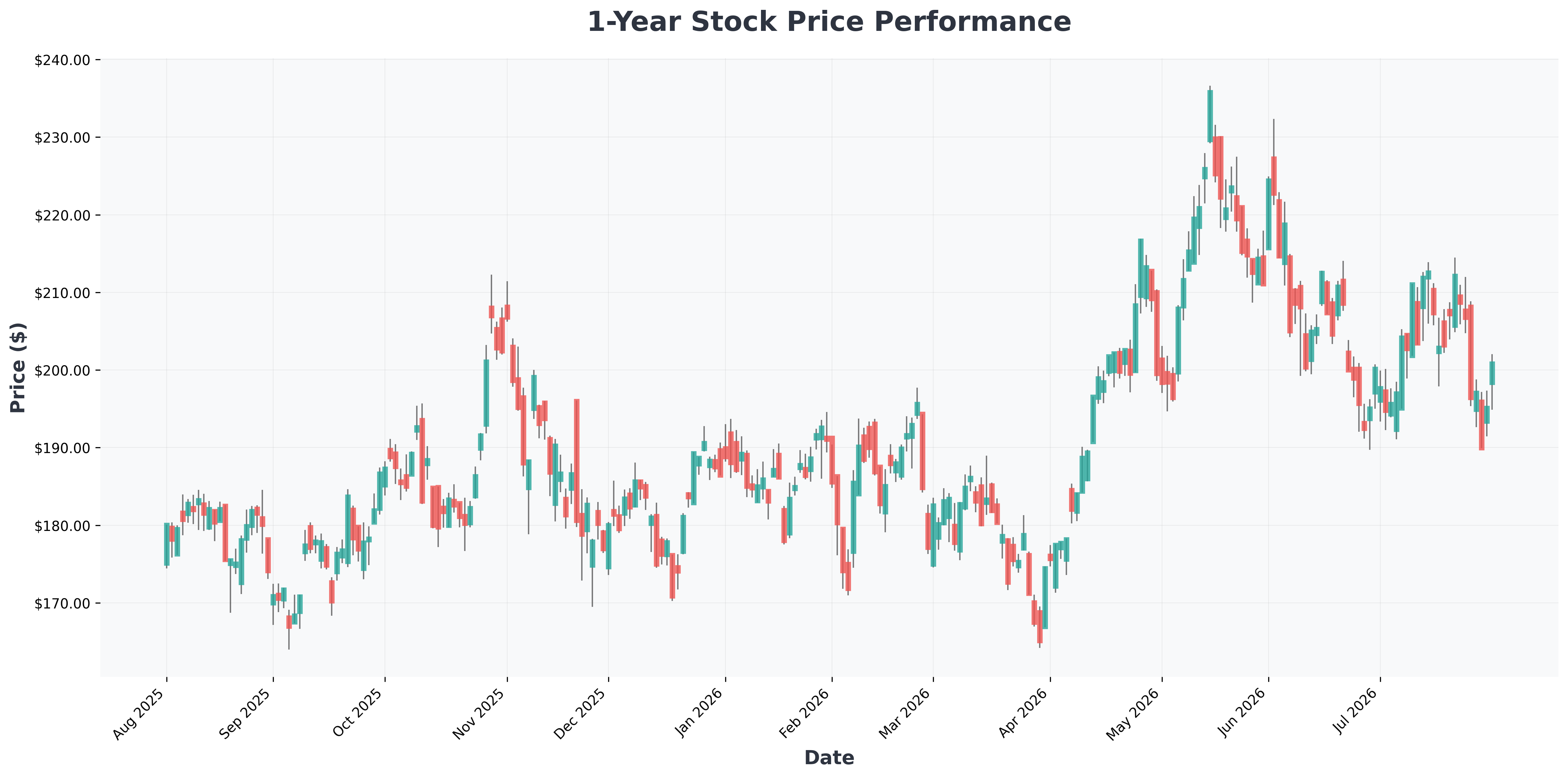
Technical Perspective: From a chart standpoint, NVDA is testing a key support zone near the $195-$200 area, which has historically attracted buyers. A decisive break below $190 could trigger a further slide toward the 52-week low of $164. However, the relative strength index (RSI) is approaching oversold territory, suggesting a technical bounce could materialize soon.
📊 In-Depth Fundamental Analysis
| Company | Share Price | P/E Ratio | P/B Ratio | ROE | Operating Margin (OPM) | Revenue Growth |
|---|---|---|---|---|---|---|
| AMZN (Amazon.com,) | $272 | 21.83 | 6.61 | 30.56% | 13.69% | 19.60% |
| AAPL (Apple) | $309 | 35.47 | 42.55 | 148.75% | 32.62% | 16.40% |
| NVDA (NVIDIA) | $201 | 30.79 | 24.88 | 114.29% | 65.60% | 85.20% |
| GOOGL (Alphabet) | $356 | 17.86 | 7.00 | 48.68% | 34.03% | 24.20% |
| GOOG (Alphabet) | $357 | 17.89 | 7.01 | 48.68% | 34.03% | 24.20% |
Conclusion: Patience Over Panic 🎯
Nvidia's recent underperformance relative to Apple doesn't signal the end of the AI trade. The company remains the gold standard in AI accelerators, and the massive capital spending by hyperscalers provides a strong revenue visibility. However, with the stock trading at a premium valuation, investors should be prepared for continued volatility.
Actionable Takeaway: Rather than timing the bottom, consider accumulating on dips during this consolidation phase. Focus on the long-term trajectory of AI adoption rather than short-term market cap rankings. The risk-reward profile remains attractive for investors with a 3-5 year horizon.
For more context on AI investment opportunities beyond Nvidia, check out our analysis of why TSMC and Broadcom are smarter AI plays right now. Also, explore how the hardware strategy showdown between Meta and Apple could reshape the consumer tech landscape.