
TSMC: Analyzing the Path to a $3 Trillion Valuation 📈
The $3 trillion market cap club is an exclusive fraternity, currently occupied only by Nvidia, Apple, and Alphabet. Taiwan Semiconductor Manufacturing (TSMC), the world's premier semiconductor foundry, is emerging as a prime candidate to join their ranks. With a current cap of ~$1.9 trillion, reaching $3 trillion would imply a 58% return for investors. We examine the fundamental drivers behind this potential ascent. 🔍

TSMC's Unassailable Moats in the AI Era ⚙️
TSMC is the indispensable backbone of modern technology, manufacturing over 90% of the world's most advanced chips. Commanding a 71% market share, it is the foundry partner of choice for tech titans like Nvidia, AMD, and Apple.
A key shift is evident in its revenue mix. While smartphone chips were once the mainstay, advanced chips for AI, data centers, and HPC now dominate, constituting 55% of sales. This directly links the AI boom to TSMC's bottom line.
Recent financials underscore accelerating growth. Q4 revenue hit $33.7B, up 26% YoY, while EPS (ADS) jumped 35% to $3.14. More impressively, the operating margin expanded 510 bps to 50.8%, signaling powerful operating leverage as its scale increases.
The market is divided on TSMC's journey to $3 trillion. Here's the Bull vs. Bear debate. 💬
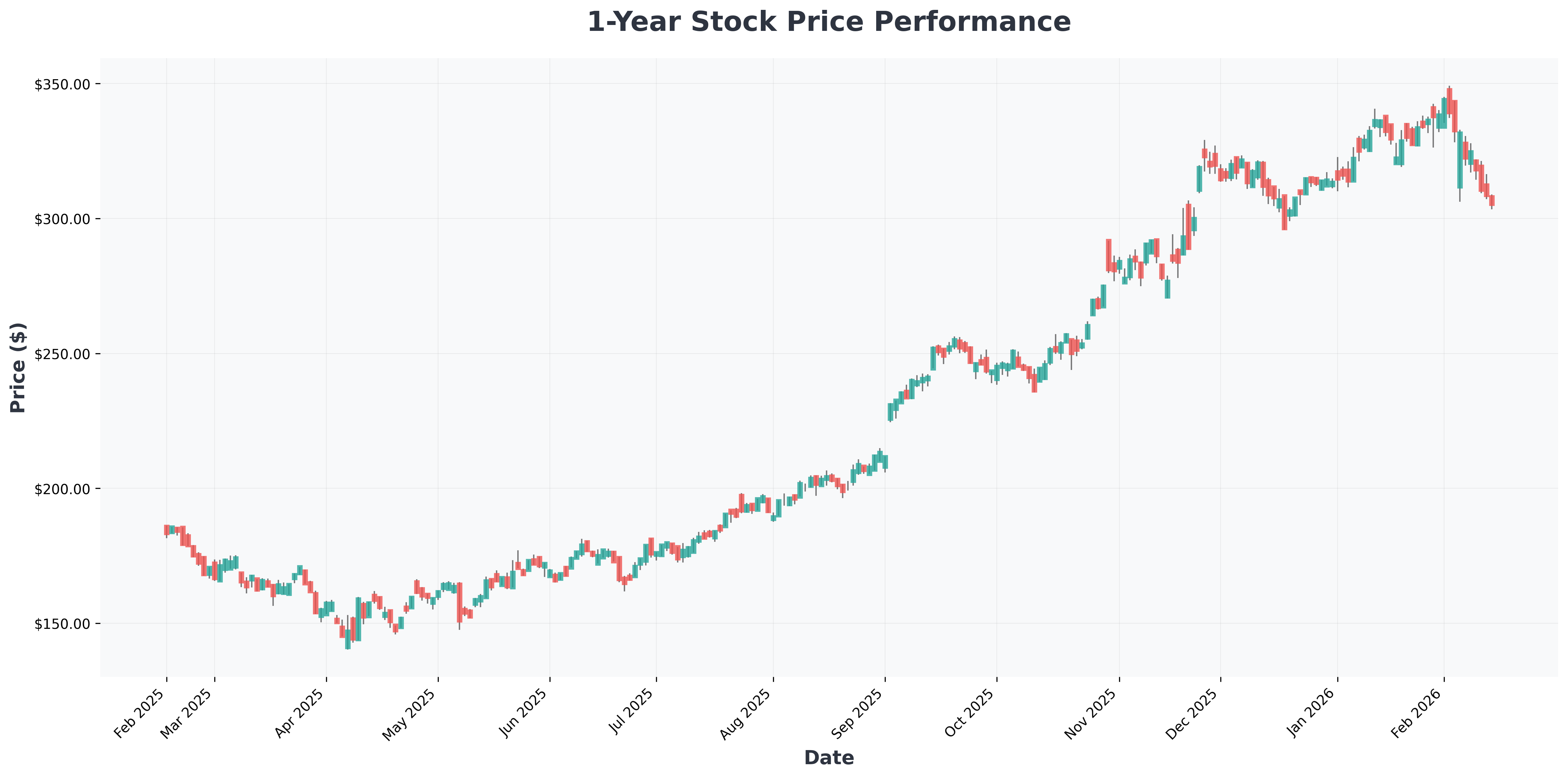

The Roadmap to $3 Trillion: A Scenario Analysis 🗺️
What would it take for TSMC to achieve a $3 trillion valuation? We break down the numbers based on current forecasts and valuation metrics.
| Metric | Current (2025 Est.) | Condition for $3T Cap (Assumption) |
|---|---|---|
| Market Cap | ~$1.9 Trillion | $3 Trillion |
| Est. Annual Rev. (2026) | $157.8B | Requires ~$250B |
| Forward P/S Ratio | ~12x | Held Constant at 12x |
| Potential Timeline | - | 2028-2029 (Based on Analyst Revenue Forecasts) |
With McKinsey projecting the high-end semiconductor market to reach ~$1 trillion by 2026, TSMC is riding a massive secular wave. Analyst consensus sees revenue reaching $193.9B in 2027 and $232.8B in 2028, putting the $3 trillion milestone within striking distance. The stock currently trades at a forward P/E of 24, which appears reasonable given its growth profile.
📊 In-Depth Fundamental Analysis
| Company | Share Price | P/E Ratio | P/B Ratio | ROE | Operating Margin (OPM) | Revenue Growth |
|---|---|---|---|---|---|---|
| TSM (Taiwan) | $366 | 34.73 | 55.12 | 35.22% | 54.00% | 20.50% |
| NVDA (NVIDIA) | $183 | 45.24 | 37.36 | 107.36% | 63.17% | 62.50% |
| GOOGL (Alphabet) | $306 | 28.26 | 8.90 | 35.71% | 31.57% | 18.00% |
| GOOG (Alphabet) | $306 | 28.34 | 8.91 | 35.71% | 31.57% | 18.00% |
| AAPL (Apple) | $256 | 32.38 | 42.64 | 152.02% | 35.37% | 15.70% |
| ARM (Arm) | $125 | 167.04 | 17.06 | 11.27% | 15.38% | 26.30% |
| AMD (Advanced) | $207 | 79.43 | 5.36 | 7.08% | 17.06% | 34.10% |

Conclusion: Focus on the Secular Growth Story ✅
The investment thesis for TSMC is straightforward: explosive demand for advanced semiconductors in the AI era is met by TSMC's virtual monopoly on their supply. Its technological lead, dominant market share, and entrenched customer base create a formidable moat.
While short-term volatility is inevitable, the long-term industry trend and TSMC's unique position within it remain compelling. Joining the $3 trillion club is an outcome; the sustained growth journey toward it is the real opportunity for investors.
Further Reading:
- Explore how policy shifts can create concentrated opportunities in sectors like nuclear, space, and quantum computing.
- For income-focused investors, check out the latest dividend declarations from Invesco's closed-end funds.
Disclaimer: This content is for informational purposes only and does not constitute investment advice or a recommendation. All investment decisions involve risk and should be made based on your own research and judgment. Past performance is not indicative of future results.