The Magnificent Seven, Revisited 📌
If you've been anywhere near the stock market over the past three years, you've heard the term. The Magnificent Seven — Apple, Microsoft, Nvidia, Alphabet, Amazon, Meta, and Tesla — were crowned by Bank of America analyst Michael Hartnett back in 2023 to describe the handful of mega-cap tech names dragging the entire S&P 500 higher.
The label stuck because it was accurate. Post-pandemic tech recovery, the ChatGPT-driven AI arms race, and Tesla's EV tipping point all converged to make these seven names the market's center of gravity.
But the market has a short memory. Three years later, the group has fractured. Amazon, Microsoft, and Tesla have all lagged the S&P 500 over the past year, and the reasons are very different for each.
In this deep dive, I'll break down the Magnificent Seven, explain why most of them still have a legitimate bull case, and reveal the one name I'd actively sell or avoid — and it's not the one most people expect.

Where the Magnificent Seven Stand Today 📊
Let's separate the winners from the laggards. The stocks still rallying aren't automatically the ones to buy, and the laggards aren't automatically the ones to avoid. Context matters.
Still Riding Momentum 🚀
- Nvidia (NVDA): The AI infrastructure king. Still the purest play on data center buildout.
- Alphabet (GOOGL): Gemini is gaining traction, and Search monetization remains a fortress.
- Meta (META): Ad efficiency from AI recommendations continues to surprise to the upside.
- Apple (AAPL): Services revenue and the on-device AI narrative keep the flywheel spinning.
Losing Ground ⚠️
- Amazon (AMZN): Heavy AI infrastructure spending is pressuring margins, and AWS is losing cloud share.
- Tesla (TSLA): BYD and Chinese EV makers are eating into global market share.
- Microsoft (MSFT): The one name I'd cut. More on this below.
For a deeper look at how Nvidia's market cap dynamics have shifted against Apple and what it means for AI spending cycles, check out our breakdown of the Nvidia vs Apple market cap shift.

The Microsoft Problem 🚨
Let me be clear: Microsoft is not a bad company. It's one of the best-run enterprises on the planet. But great companies can still be overvalued stocks — and that's exactly the situation I see today.
The Bull Case (And Why It's Fragile)
The bulls point to three things:
- 18% YoY revenue growth in the quarter ending in June
- 43% growth in Azure, where AI revenue is booked
- A $678 billion backlog of contracted business waiting to be recognized
Impressive on the surface. But dig deeper and the cracks appear.
The Bear Case 🐻
First, that $678B backlog is a double-edged sword. AI data center hardware is scarce and getting more expensive. Microsoft's cost to actually deliver that revenue isn't locked in. Shareholders could end up footing a much bigger bill than expected.
Second, Copilot is struggling. Despite 30 million paid users on the professional tier at $21–$38/month, enterprises are asking a fair question: why pay for Copilot when ChatGPT, Gemini, and Claude are cheaper or free? Microsoft will run out of willing enterprise buyers sooner than most expect.
Third, the Windows franchise keeps weakening as mobile devices displace PCs. The consumer Copilot isn't gaining share while Gemini and Claude are. Xbox revenue dropped 10% last quarter after a 5% decline the quarter before.
Key Metrics Snapshot
| Metric | Value | Signal |
|---|---|---|
| Market Cap | $3.8T | 🔴 Stretched |
| Gross Margin | 67.94% | 🟡 Compressing |
| Dividend Yield | 0.71% | 🔴 Minimal cushion |
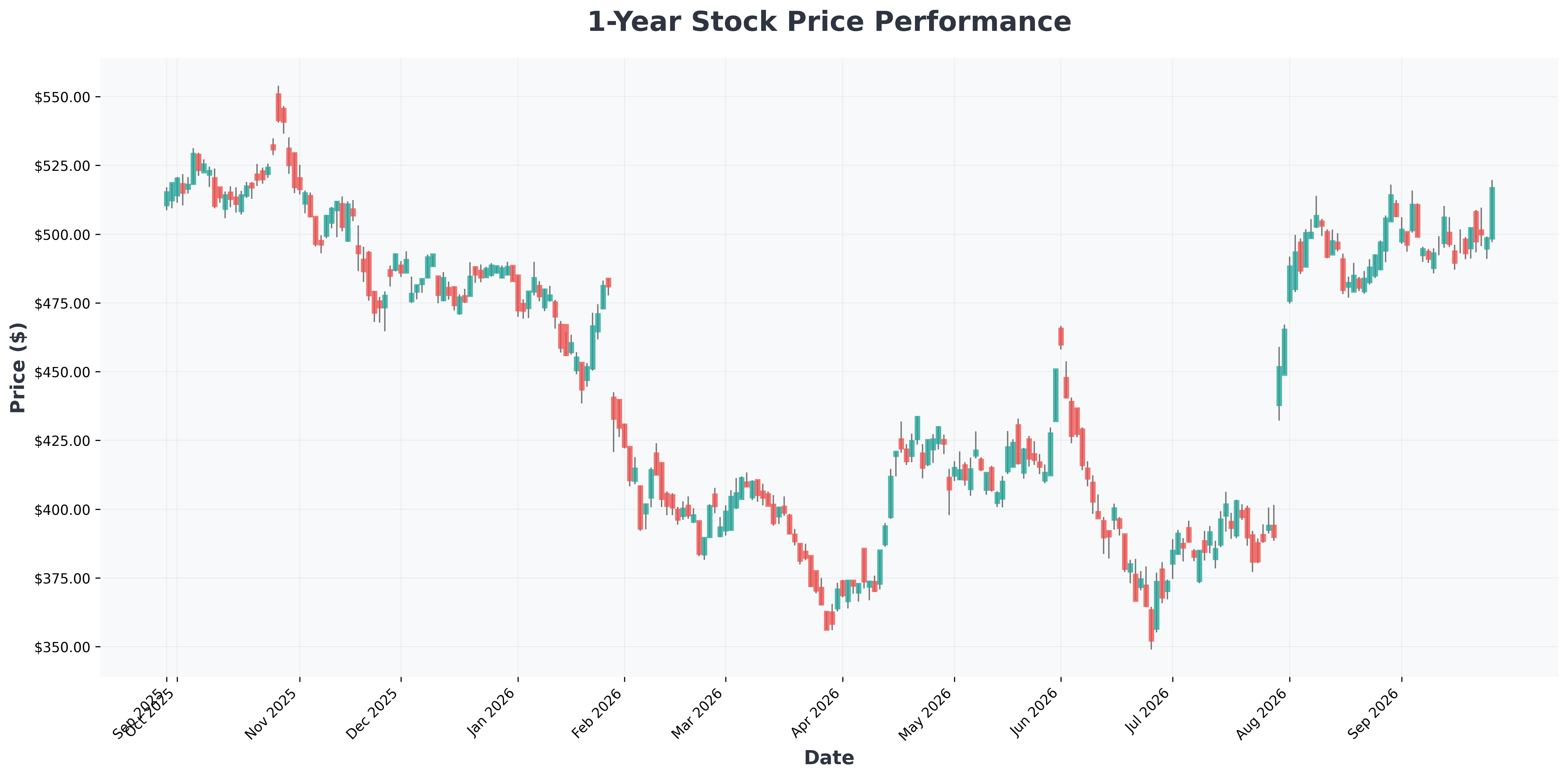
| 52-Week Range | $349 – $554 | 🟡 High volatility |
| Avg Volume | 32.4M | 🟢 Liquid |
From a technical standpoint, MSFT is trading near the upper end of its 52-week range, with the $500 level acting as a psychological support zone. A clean break below that could open the door to a retest of the $450 area — a level that historically attracted institutional buyers.
If you're weighing Microsoft against other defensive income plays, our bond ETF comparison for 2026 is worth a read.
The market is split on Microsoft. Here's how the two camps are framing the debate right now:
📊 In-Depth Fundamental Analysis
| Company | Share Price | P/E Ratio | P/B Ratio | ROE | Operating Margin (OPM) | Revenue Growth |
|---|---|---|---|---|---|---|
| NVDA (NVIDIA) | $225 | 28.49 | 23.73 | 117.21% | 66.24% | 105.90% |
| TSLA (Tesla,) | $372 | 344.55 | 16.92 | 4.67% | 1.41% | 25.50% |
| META (Meta) | $752 | 28.33 | 7.33 | 29.85% | 34.83% | 28.00% |
| AAPL (Apple) | $341 | 39.07 | 46.34 | 148.75% | 32.62% | 16.40% |
| GOOGL (Alphabet) | $344 | 17.27 | 6.76 | 48.68% | 34.03% | 24.20% |
| AMZN (Amazon.com,) | $250 | 20.09 | 4.88 | 30.56% | 13.69% | 19.60% |
| GOOG (Alphabet) | $341 | 17.12 | 6.70 | 48.68% | 34.03% | 24.20% |
| MSFT (Microsoft) | $516 | 28.72 | 8.67 | 34.04% | 45.11% | 17.70% |

Scenario Planning: Where MSFT Goes Next 🔮
Best Case (Bull Scenario) 🟢
- Azure AI revenue converts to profit faster than expected
- Copilot enterprise adoption accelerates past 50M users
- Windows and Xbox stabilize
- Price target: $600–$650
Worst Case (Bear Scenario) 🔴
- AI capex costs balloon, compressing margins
- Enterprise Copilot churn accelerates
- Broader AI spending slowdown hits Azure growth
- Price target: $400–$430
Base Case (Most Likely) 🟡
- Modest Azure growth deceleration
- Copilot plateaus around 35–40M users
- Stock trades sideways in the $480–$540 range for 2–3 quarters
The Bottom Line 💡
Most of the Magnificent Seven still have legitimate bull cases. Microsoft is the exception. The stock is priced for perfection on an AI story that hasn't fully materialized, while its core franchises — Windows, Xbox, and Copilot — show real signs of fatigue.
If you own MSFT, this is a reasonable moment to trim. If you don't, there are better places to put new capital in 2026.
Disclaimer: This is analysis, not financial advice. Markets carry risk — always do your own due diligence and never invest more than you can afford to lose.
Related Reading